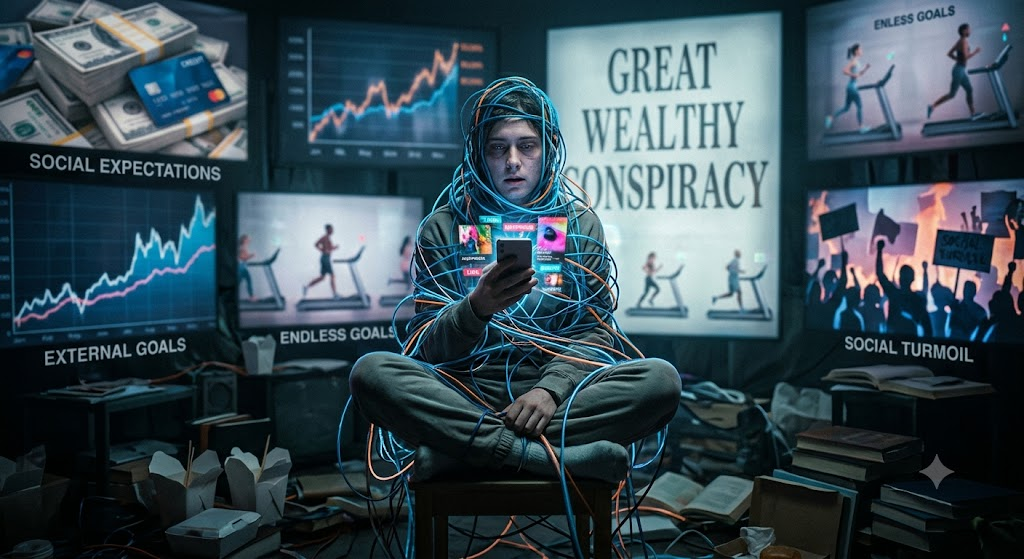
When "artificial happiness" becomes a constraint: why do we feel more fatigued the more we entertain ourselves?
Have you ever had this experience? After crazily scrolling for two hours through short videos, your fingers keep sliding down, and your brain is racing with stimulating music and plot twists. But when you finally turn off the screen, what greets you is not relaxation and satisfaction, but a huge emptiness, anxiety, and an indescribable physical and mental fatigue.
We live in an era of overproduction of "artificial happiness." However, these carefully designed "instant gratifications" are quietly depriving us of the ability to experience true happiness.
1. The psychological cage of short videos: fed attention
Short videos, algorithms, and endless social notifications are essentially alow-cost form of psychological entertainment.Their danger lies not in "wasting time," but inoccupying our mental bandwidth.。
When the brain is filled with a continuous stream of brief stimuli, we are actually trapped in an infinite loop of "constantly anticipating the next stimulus." This state completely stifles our ability to engage in deep thinking, reflect on life, or even just to simply empty our minds. You have no space to think about "what I truly want," because your brain is busy digesting the next 15 seconds of hilarious memes. This extreme exploitation of attention ultimately leads to "hedonic fatigue"—dopamine receptors become numb due to overstimulation, resulting in a lack of motivation for anything.
2. The "rich man's grand conspiracy": designed addiction mechanisms
From a broader perspective, this can even be seen as a "grand conspiracy of the rich (or the elite)."
In the top logic of capitalism, attention is the most valuable currency. Tech giants hire the world's top psychologists and neuroscientists, with the sole goal of:how to keep your eyes glued to the screen.
When the lower or middle class indulges in this cheap, easily accessible artificial happiness, the collective reflective capacity of society declines. People lose their sharpness regarding real issues, forgetting to think about deeper social structural problems like class inequality and uneven resource distribution. This form of entertainment has become the best "mental anesthetic" of contemporary society.
3. The traps of the external world: social expectations and false goals
In addition to the constraints of technology, another core reason we cannot calm down lies inthe expectations of society and others towards you.。
Modern society has tailored a "standard happiness template" for us: buying a car, buying a house, earning a million a year, becoming an elite. We run like hamsters on a track, crazily chasing these goals set by the external world. However,achieving these goals does not necessarily make you happy.
The cost of blind pursuit: when you finally get that title or salary, you will find that happiness is fleeting, replaced by the immense pressure to maintain that status.
The kidnapping of expectations: our anxiety often comes from "fearing that we cannot keep up with others." This anxiety, shackled by external values, prevents us from ever attaining true inner peace.
4. Breaking free from artificial happiness, regaining true perception
In this era of social turmoil, information explosion, and collective anxiety, pursuing "artificial happiness" is like drinking saltwater to quench thirst; the more you drink, the thirstier you become, and the thirstier you are, the more fatigued you feel.
To break this vicious cycle, we need to learn "active disconnection." Try turning off the algorithm's feeding, and endure the initial few minutes of boredom and emptiness. When you regain control of your attention and no longer treat external social KPIs as the only compass in life, you will discover: true happiness often lies in those real-life experiences that cannot be quantified or calculated by algorithms.